..........................................................................................................................................................................
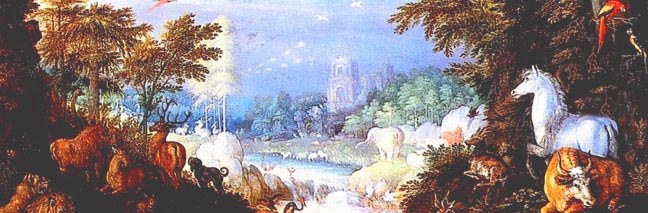
Orpheus
from Visipix
The
Incredible Journey of Solon According to Plato's Dialogues; Solon traveled to Egypt to enquire about Greek history and negotiate trade deals between Greece and Egypt. Solon wrote an ancient tale of the mysterious and elusive empire of Atlantis that has captivated the imagination of scholars, archeologists, historians, psychics, treasure-seekers, adventurers, philosophers and poets, for over two thousand years. Solon's Atlantis Code: The Atlantis Motherland book presents a dramatic new perspective of this age old mystery which is recorded in The Dialogues of Plato in his works entitled Critias and Timaeus. The Atlantis Motherland book deciphers a secret code to an intricate puzzle, that was designed by the Egyptians and perpetuated by Solon, to conceal the true location of Atlantis, while preserving the history of the early ancestors of both the Egyptians and the Greeks. The entire history of Atlantis might have lost except for a meeting that occurred in Egypt, in the early 6th century BC, between the charismatic Greek statesman, Solon, and an aged Egyptian priest. Solon learns the history of Atlantis in Egypt While visiting the priests of Sais, Solon learned the story of a magnificent ancient civilization that disappeared 9,000 years earlier. An Egyptian priest of very great age, named Sonchis, told Solon an incredible tale of ancient empires, natural catastrophes and a great war. Sonchis harshly criticized Solon for telling mythological Greek fairy tales, regarding the deeds of the past; and scorned Solon's lack of knowledge of the true history of his honorable and heroic Athenian ancestors, who had bravely advanced alone against a seemingly invincible adversary, during an ancient nearly forgotten war. Softening his stern manner, the aged priest of Sais, then explained to Solon why the Egyptians still retain the ancient records and why the Greeks do not. As a consequence of the many natural catastrophes that had befallen Greece. He also adamantly assured Solon that the events he was revealing, although seemingly fantastic, were indeed, absolutely true. Sonchis praised the valor and wisdom of Solon’s ancestors; who created a most honorable and noble nation, known as ancient Hellas; the land of the Hellenes. The aged Egyptian priest proceeded by describing the incredible size and grandeur of the magnificent empire of Atlantis. Its capitol city contained elaborately intricate, yet strange and barbaric appearing temples and palaces, filled with exotic golden, silver and ivory treasures. Sonchis described great metal-clad walls surrounding circular islands which protected the citadel of a vast metropolis. The intriguing tale of great lost treasures fascinated Solon; being a successful merchant, he instantly recognized the tremendous treasure hunting opportunity that was being presented. If he could find this lost empire, riches such as the world had never seen would be his for the taking. Even greater opportunities of discovering the advanced technologies that were employed to build this magnificent empire, might also be gained for the benefit of all the citizenry of Greece. With the help of Egyptians scribes, Solon began translating the treasured historical records, into the Greek language, vividly depicting the amazing ancient events and deciphering the names of the characters in this ancient epic saga. Solon thought the proper names recorded in the Egyptian records were too unfamiliar to Greek citizens, so he changed all the names to Greek names that were familiar to the Greek people. Unfortunately, he did not record the original Atlantean names, or the Egyptian names. Solon invented the name Atlantis. He named the adversaries of his Greek ancestor's empire, Atlantis, in honor of the ancient Greek Titan, Atlas, who faught against the Greek god, Zeus in a war between the Titans and the Greek gods. Therefore to this day, the mysterious sunken island is known as Atlantis. The Atlantean Province of Egypt was located in Colchis. Sonchis revealed to Solon that Egypt, was founded in 8,600 BC, which is one thousand years after he said Atlantis had disappeared. He also revealed that the province of Egypt had been subjugated by the Atlantean kings before the war, which clearly indicates that the province of Egypt was located somewhere other than Egypt as they knew it in Solon's time.
According to Herodotus, Egyptians occupied the area of Colchis (ancient Vani) at the eastern end of the Black Sea. Herodotus states that these Egyptians knew more about Egyptian history than the Egyptians themselves. Egypt is famous for its beautiful golden artifacts. Colchis is famous for its rich gold deposits which filled the mountain streams with an abundance of gleaming gold nuggets and sparkling fines. Colchis was the destination of Jason and the Argonaut's journey, in the ancient tale of their mighty quest to seize the "golden fleece." The traditional method of mining in this area was to place sheep skins in the streams and let the stream deposit the gold nuggets into the fleece.
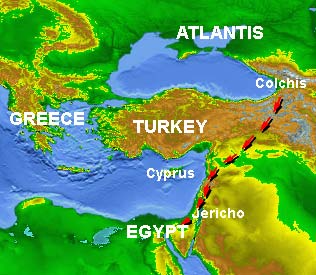
The Colchis Egyptians scribed the events of the terrible misfortune that befell their beloved families and friends on golden tablets, which were lovingly washed by their tears as they worked. Widespread disease generated from the putrid debris, caused by massive the Earth changes, combined with changing climate conditions, caused the early Egyptians to move on to new lands, eventually settleing along the Nile, in 8,600 BC. The survivors and their descendants, erected temples and monuments to honor their ancestors, and to try to preserve as much knowledge and technology as possible. Although it would take thousands of years to regain much of the knowledge that had been lost during the massive Earth changes that Solon called, "a single day and night of misfortune." The survivors gathered their most sacred possessions, ools, and animals and migrated far away from the treacherous sea, following old migration routes; they traveled to the Middle East and then to the Nile. This migration took one thousand years, placing the Egyptians at the eastern end of the Mediterranean Sea, instead of the eastern end of the Black Sea, where they had previously dwelled. Knowledge of the existence of Black Sea disappeared for thousands of years. The Egyptians found a new empire along the eastern Mediterranean Sea.
Only the Egyptian priests had the great responsibility of preserving the history of their ancestors. This became the sole purpose of the priests of Sechat; they preserve the sacred ancient records and protect the secret location of their sacred Motherland from falling into the hands of their enemies, seafaring competitors, and marauding barbarians. The ancient Egyptian priests also had the great responsibility of providing the citizens with a common history and spiritual beliefs that would unite the diverse populous and cause them to honor the Pharaoh and build a strong and prospering united nation. The priests and scholars in Egypt, about 8,600 BC, realized they now lived on the Mediterranean, instead of the Black Sea. Surely great debates occurred among them as they deciphered the sacred golden tablets which their ancestors had tearfully scribed a thousand years earlier. The Egyptians translated the names of the Atlantians into the names of the gods and goddesses that
were popular at the time. The geographical names were translated
into various locations around the Mediterranean. In this way, they could retain their history, while protecting the location of Atlantis from being looted. Only the highest priests and royalty of Egypt were allowed to view the secret records of
their sacred motherland.
About 3,500 BC there was a flowering of Egyptian culture. The royalty and priests of Egypt became eager to discover if the ancient records about Atlantis were actually true. Scouts were sent out to retrace their migration routes. Egyptian ships were launched on voyages to jpurney all over the world and created a map of all the Tribes of the Earth. The priests of Egypt finally located the homeland of their ancestors in modern Georgia, which was known as Colchis in Solon's time. This is the land visited by Jason and the Argonauts to claim the golden fleece. The Egyptians sailed along the precipitous cliffs, lining the northern Black Sea. They fit the description recorded in the sacred records perfectly. They found the shoals of mud that blocked the entrance to the Sea of Azov, where the Island of Atlantis sank. There they had found the remnants of the empire of Atlantis. They had proven that the ancient records were true. The Egyptians sent political envoys, priests and expeditions to their sacred motherland. The city of Atlantis did not completely sink during the earthquakes, but the violent earthquakes, torrential floods and tidal waves had left the ruins of Atlantis randomly strewn everywhere. The Egyptians erected memorials and built elaborate burial vaults to honor to their ancestors. Great hordes of treasures were waiting everywhere to be excavated. The precious metals that coated the great walls of the city were easy mining. Gold, silver, orichalcum and ivory treasures were collected and transported across the mountains of Turkey to Egypt, because the Bosporus had not become navigable yet. "PILLARS" is the secret code for "SYMPLEGADES" (BOSPORUS)
An old sea-traders trick of misnaming the straits that you sail through was employed. The Pillars of Heracles is actually the Bosporus Strait, formerly known as Symplegades. After the Bosporus became navigable the Egyptians required safe passage through the Dardanelles. Sonchis decided to trust Solon and reveal the true location of Atlantis, in return for Greek cooperation in extracting the treasures of Atlantis. Before receiving the 9,000 year old secret, Solon pledged a vow, to never reveal the secret to finding Atlantis. Solon listened, with great interest, as Sonchis
described the route to Atlantis; The physical description of the Pillars of Heracles matches exactly the geography stretching between the Aegean Sea and the Black Sea. This geological description was retained in the sacred transcripts, but the place names were purposely altered to send competitors out of the Mediterranean Sea, through the strait of Gibraltar and into the Atlantic Ocean, in a futile search for treasures of Atlantis. "International conspiracy" to protect the treasures of Atlantis Before the opening of the Bosporus, the most direct route from Egypt to Atlantis was across Asia Minor (Turkey). The Egyptians established a trade route across the Taurus and Pontic mountains, rather than following the old migration route around the east end of the Black Sea. The Egyptians needed to bargain with foreign kings and mercenaries in order to secure safe passage through foreign nations along the route across Turkey. The wary priests and royalty of Egypt carefully
guarded the secret of the true location of Atlantis. They only revealed
the truth when absolutely necessary, and only then when they were
certain that they were bargaining with honorable kings, generals
or wealthy merchants, who would honor their vow of secrecy. When
all the necessary agreements were made, the Egyptians launched expeditions
and sent caravans to bring the fabulous wealth of Atlantis by ship
to Turkey, then across land to the Mediterranean Sea.
" there were ... gardens and places of exercise, ... for horses in both of the two islands formed by the zones; and ... there was set apart a race-course of a stadium in width, and in length allowed to extend all round the island, for horses to race in." >> read full quote
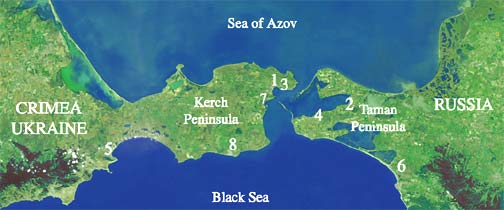
Horses were very important in Atlantis. A race track for horses ran around the complete circumference of the island. The Atlantians built special bathes for both their beloved cattle and horses within the gardens of the mail islands of the city. Currently science believes that horseback riding originated on the Ukrainian steppes about 4,000 BC, although strong evidence of bridles and hobbles support a much earlier date, around 20,000 BC. Before 20,000 BC, freedom seekers from Atlantis had taken their horses around the world with them during the early migrations. After 10,000 BC all the horses in the world were almost extinct. Only in the lands of our motherland Atlantis was their survival was ensured because their horses were so revered. The descendants of Atlantis loved their horses and knew they needed them to rebuild their homes and lives. By 4,000 BC many tribes were established north of the Black Sea. Their cities and towns were built on stilts. They were ready at a moments notice to pull their wagons under their houses and leave the area in case of natural disaster or invasion. They defeated their enemies by refusing to fight them. The Trypillians had no weapons. Atlantis was the land of the Bull (Tauri) The Egyptians negotiated peaceful trade agreements with the Tauri, who were the descendants of the survivors of the inundation of Atlantis. The Tauri had also returned to their sacred motherland; but they had lost most of the knowledge of their past, and they had also lost most of the knowledge of the advanced technologies of Atlantis, just as the Greeks had. The Tauri, however, had maintained their greatest treasure, which were their horses. They developed a nomadic horseman culture, so they were always ready to flee sudden danger, from warring tribes or from the unpredictable whims of mother-nature. The Tauri gave birth to many of the nomadic tribes of the southeastern European steppes; they were the horse-breeders of the mighty war-horse of the Don. The Egyptians transported horses, a living treasure of Atlantis, back to Egypt. By carefully breeding the little horses from the Azovian steppes, which were the remnants of the magnificent mounts of the Atlantean Kings, the Egyptians developed the elegant Arabian horse. In return for the great treasures they took to Egypt, the Egyptians paid tribute to the Tauri with exotic imports from Egypt and other ports around the Mediterranean Sea. They remained at peace for many years. The Egyptians excavated a wide variety of ancient treasures, and they mined out the entire coating of the orichalcum wall of the metropolis of Atlantis, smelting it at the metallurgical complexes located on the Island of Cyprus, before transporting it on to Egypt for domestic use and foreign trade. Their great enterprise was, of course, periodically interrupted by invasions of barbarians, civil unrest, famine, disease, political intrigues and natural disasters. Fortunately, the sacred records of Atlantis were carefully preserved, by the Egyptian priests, through the passing millennia. The "Golden Touch" of King Midas The Atlantis Motherland dramatization, based on archeological, mythological and historical records, continues in the 8th century BC; At that time, endeavoring to sail up the treacherous currents of the Bosporus was still a death defying feat. The Egyptians entered into negotiations with King Midas of Gordion in Phrygia (Mushki), for the purpose of acquiring safe passage across Turkey. The Egyptians and Phrygians, agreed to establish an outpost on Kerch Strait, which King Midas named Panticapaeum, in honor of the God, Pan. Another outpost was established at the north end of the Sea of Azov, called Tanais (modern Rostov-on-Don). This time the invasion of colonists into the former Atlantian Empire angered the Kimmerians, who were the current inhabitants of Atlantis. They took great offense at being robbed, by King Midas, of what they naturally considered to be their own treasures. They formed an alliance with their neighboring tribes (the Scythians and Tauri) and mounted an attack against the land of King Midas. The Kimmerians scorched the earth and blockaded Phrygia. The population of Phrygia grew hungry and Midas was forced to return the confiscated booty to the Kimmerians and abandon Panticapaeum. The Kimmerians, still angry, vowed to defeat Egypt. They continued pressing onward, waging war through the Levant as they aggressed on toward Egypt. Fortunately, a peace agreement was agreed on before they reached Egypt, and most the Kimmerians returned to their motherland, but some remained in Anatolia. Midas realized his lust for gold had caused his nation to be invaded and decimated. Midas then rejected the desire for great wealth and adopted the ancient Athenian philosophy of living a simple life in harmony with the land. Tales of the exotic golden treasures, that King Midas once held in his possession, gave birth to the legend of the "golden touch" of King Midas. Greeks build colonies on the Kerch and Taman Peninsulas. After Solon returned from visiting Egypt, the Greeks eagerly established colonies on the Kerch and Taman Peninsulas (Cimmerian Bosporus), where the metropolis of Atlantis once flourished. The colonies grew quickly, supported by the treasures the Greeks extracted from our sacred motherland.
The ancient stones that had once been used in the construction of the temples of Atlantis were re-hewn to build their new temples, palaces and homes. The ancient quarries of Atlantis were reopened and the red, white and black building stones were once again being extracted, hewn and used to construct the beginnings of a new empire. The extremely fertile soil, surrounding Kerch strait, raised abundant crops of wheat that were transported back to Greece. Concealed beneath the piles of wheat sheaths, the valuable cargo of the treasures of Atlantis were also transported to Greece and to Egypt, and sold and traded throughout the Mediterranean area and beyond. Solon never revealed the secret of the "Atlantis Code."
The ancient Egyptian "Atlantis Code" protected the secret location of Atlantis for thousands of years, sending explorers, adventurers and treasure seekers to locations in and around the Atlantic Ocean and beyond, while the Island of Atlantis lay silently, beneath thousands of years of accumulating alluvial deposits, in the Sea of Azov. Searching for the "divine portion." Solon's ancient transcript recorded more than the details of history, and the geography of ancient adversaries; it also recorded the great wisdom of the aged Egyptian priest, who challenges us to search for more than lost civilizations, and hidden treasures, but also to search for a greater treasure, which Solon called the "divine portion" within us. By nurturing this "divine portion," we may be able to re-awaken the peaceful primal culture of Atlantis, and the honorable eco-friendly culture of the ancient Hellenes. By growing the divine portion in our human spirit, we may awaken the secret to establishing peace between all the members of our beautiful Blue Planet tribe. Ultimately, we are all one family. We are all descendants of our primeval earthborn ancestress, and an adventurous and amorous visiting "god." They fell in love with each other, and founded our ancient motherland, Atlantis. Thanks to Solon’s curiosity, wanderlust, seamanship, statesmanship, and talent for business and prose, he was able to acquire and record a history that, accept for his efforts, might have lost forever. copyright: COSMIC VORTEX, 2007 |
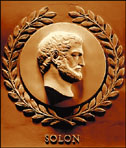 Solon,
c. 638 BC – 558 BC, was a highly respected Greek statesman, poet and famous sage, who
was renowned for his fairness, wisdom and mesmerizing orations.
He was the great law-giver of Athens.
Solon,
c. 638 BC – 558 BC, was a highly respected Greek statesman, poet and famous sage, who
was renowned for his fairness, wisdom and mesmerizing orations.
He was the great law-giver of Athens. 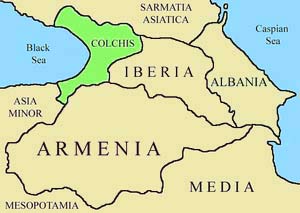 Valuable information to aid in determining the location of the Atlantean province of Egypt, is recorded in, The Histories by Herodotus, written from the 450s to the 420s BC.
 The
streams filled with gold, located in the Atlantian province of Egypt, flowed down through
the mountain valleys and foothills. The great earthquakes and floods
that destroyed Atlantis left many of the rich mountain villages
in Colchis relatively untouched by the cataclysmic disaster.
The
streams filled with gold, located in the Atlantian province of Egypt, flowed down through
the mountain valleys and foothills. The great earthquakes and floods
that destroyed Atlantis left many of the rich mountain villages
in Colchis relatively untouched by the cataclysmic disaster.  The
Egyptians arrived at the eastern end of the Mediterranean Sea, in
8,600 BC. They discovered fertile soil and mild climate. This was
the perfect place to found their new empire. As each generation
raised their crops and then returned to soil, the ancient plowers
expanded their new kingdom down the Levant and into the Nile delta.
As they mixed with the local indigenous tribes, their pantheon of
gods and goddesses, myths and history became mixed with the local
traditions. The citizens forgot the true names of their ancient ancestors, and just as their magnificent city had disappeared beneath the sea, so also did the true name of their motherland disappear beneath the sands of time.
The
Egyptians arrived at the eastern end of the Mediterranean Sea, in
8,600 BC. They discovered fertile soil and mild climate. This was
the perfect place to found their new empire. As each generation
raised their crops and then returned to soil, the ancient plowers
expanded their new kingdom down the Levant and into the Nile delta.
As they mixed with the local indigenous tribes, their pantheon of
gods and goddesses, myths and history became mixed with the local
traditions. The citizens forgot the true names of their ancient ancestors, and just as their magnificent city had disappeared beneath the sea, so also did the true name of their motherland disappear beneath the sands of time.
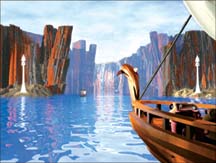 The
Atlantis Motherland project states that a simple, but very effective,
secret code was devised by the Egyptians to protect the location
of their sacred motherland from being defiled by barbarians and
looters.
The
Atlantis Motherland project states that a simple, but very effective,
secret code was devised by the Egyptians to protect the location
of their sacred motherland from being defiled by barbarians and
looters. 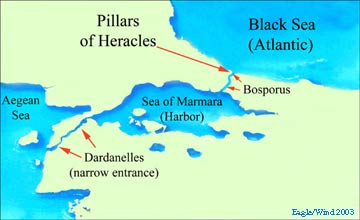 You
enter straits having a narrow entrance (the Dardanelles) then you
sail into a small sea or harbour (the Sea of Marmara) then through
the Pillars of Heracles (Bosporus) and on into the true sea (Black
Sea).
You
enter straits having a narrow entrance (the Dardanelles) then you
sail into a small sea or harbour (the Sea of Marmara) then through
the Pillars of Heracles (Bosporus) and on into the true sea (Black
Sea). 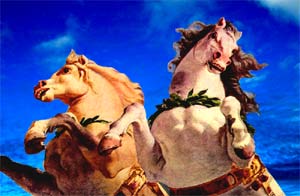
 Solon
kept his promise to the Egyptian priests and never revealed the
true location of Atlantis. Fortunately, his unfinished manuscript
was passed down through the generations. One hundred and eighty
years after Solon's visit to Egypt; his unfinished epic tale was
recited during a meeting to plan a festival for the goddess, Athene.
The account of this meeting was recorded by Plato, and survives
today in his works entitled
Solon
kept his promise to the Egyptian priests and never revealed the
true location of Atlantis. Fortunately, his unfinished manuscript
was passed down through the generations. One hundred and eighty
years after Solon's visit to Egypt; his unfinished epic tale was
recited during a meeting to plan a festival for the goddess, Athene.
The account of this meeting was recorded by Plato, and survives
today in his works entitled
|
References and related articles (External links open a new window): Map of Tauricus and Colchis, Azov, Bosporus, Cimmerians, Symplegades, Kerch, Panticapaeum, Solon, Vani, Colchis, King Midas, Tanais, Phrygia, Cyprus, History of Agriculture from Wikipedia. Map of Greek Colonies; Panticapaeum, from Ancient Greek and Hellenistic Settlements. Pyramids in Crimea, Ukraine, from The research group of professor Gokh V.A. (Thanks to Wisteria at AR forum for the link). Map of Pyramids in Crimea, posted on the Graham Hancock Message Boards. The Crimea: Scythian/Greek dualism, Royal Mound, The Stone Foundation, from Encyclopedia of Ukraine. The Gordion Archaeological Project at Gordion, Turkey, by the University of Pennsylvania Museum of Archaeology and Anthropology (UPM). Gordion Excavation Project, Site maintained by R.C. Henrickson The necropolis of Pantikapaion (Kerch, Crimea), by Friederike Fless. Polis and Chora in the Kingdom of Bosporus, by Sergey Saprykin Inscriptions of the North Coast of the Black Sea, Inscriptions by Region. (not available in English) Equus Gmelini - Tarpan, Edited by R.A. March 16, 2004. The
Natufian Culture in the Levant, Threshold to the Origins of Agriculture,
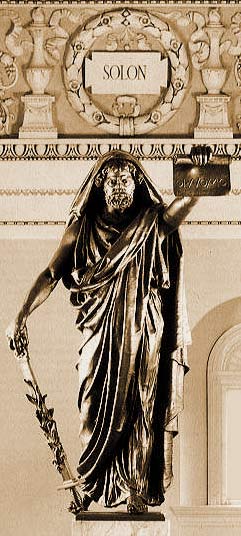
by OFER BAR-YOSEF. Map, page 2. The Birth of Coinage, by Robert Mundell, Dept. of Economics, Columbia University, Sept. 1999. Images on this page: Solon (638?-559? BC.), Sculptor, Brenda Putnam, located on North Wall, US House of Representatives. OI NOMOI ("the law"), bronze sculpture of Solon stands in the Library of Congress. Sculptor: Frederick Wellington Ruckstall. Colchis Map, public domain, adapted from Wikipedia. Route from Colchis to Egypt, adapted from World Topo map, USGS. The sun horses of Apollo frescos in the emperor hall, adapted from Visipix. |
|
The Atlantis
Motherland websites present an epic adventure
and a revolutionary history of Atlantis, Purchase Atlantis Motherland Book! Atlantis Motherland
book presents evidence
that Atlantis was a reality Live in Harmony. Enjoy Life! Contact: webmaster@mauivortex.com opyright: Cosmic Vortex, 2006, Maui, Hawaii, USA |